PROJECT 05 · PERFORMANCE ANALYSIS
Distributed Training Profiler
Updated: May 2026
Built a systems profiler for analyzing communication overhead, memory bottlenecks, scaling efficiency, and optimization trade-offs in distributed ML workloads.
Problem
Distributed training can become communication- or memory-bound as worker count and model size grow. The profiler makes those constraints explicit before expensive runs.
Technical Highlights
Python · Distributed Systems · All-Reduce · Performance Modeling · ZeRO
- Communication versus compute bottleneck analysis
- ZeRO memory optimization simulation
- Scaling-efficiency and overlap analysis
System Design
- Distributed training-step simulation
- Ring all-reduce communication modeling
- Communication-computation overlap analysis
- GPU memory-feasibility estimation
- ZeRO-1, ZeRO-2, and ZeRO-3 optimization modeling
Architecture
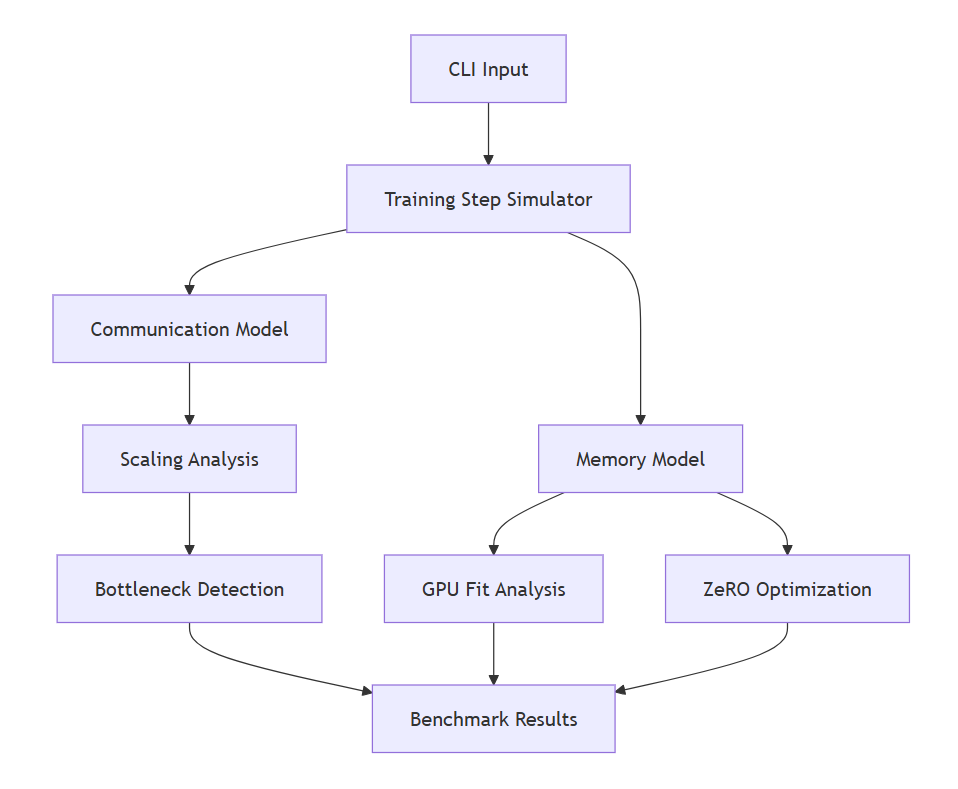
The simulator combines compute, communication, overlap, and optimizer-state models to expose step-time and memory bottlenecks across configurations.
Results and Insights
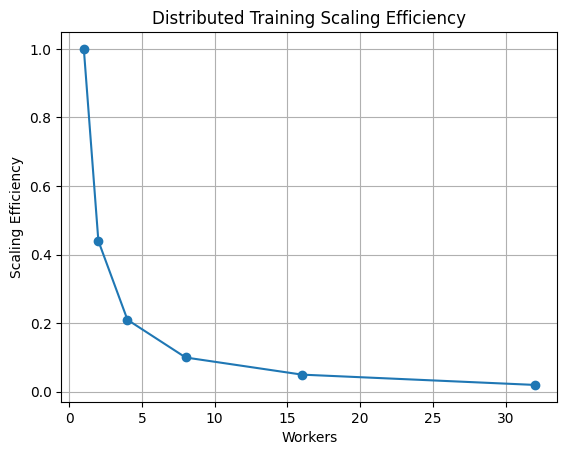
- Communication overhead increases with worker count.
- Scaling efficiency degrades as synchronization dominates execution.
- Compute overlap reduces effective synchronization cost.
- Large models rapidly become memory-bound.
- ZeRO optimization substantially reduces memory requirements.
Takeaway
Distributed performance depends on the interaction between compute, synchronization, memory capacity, and the optimization strategy.